
Red Hat OpenShift Container Platform and F5 BIG-IP series load balancer integration
Disclaimer: Links contained herein to external website(s) are provided for convenience only. Red Hat has not reviewed the links and is not responsible for the content or its availability. The inclusion of any link to an external website does not imply endorsement by Red Hat of the website or their entities, products or services. You agree that Red Hat is not responsible or liable for any loss or expenses that may result due to your use of (or reliance on) the external site or content.
F5 BIG-IP Local Traffic Manager (LTM) series load balancers features programmable cloud-ready appliances/virtual appliances with Layer 4 and Layer 7 throughput and connection rates. As an industry standard (widely deployed solution) it is only natural that IT departments would want to leverage existing appliances to provide high throughput performance to kubernetes (OpenShift) deployments.
Because Red Hat and F5 are market partners who have jointly developed an integration between our two products, its important that we outline exactly how / in what ways customers can and should leverage the two products together.
Through this partnership we provide a joint support of the solutions that are offered and designed. For more information please read our third party support statement.
- Both Red Hat and F5 are TSANet Support Partners.
With the flexibility of OpenShift you can both front OCP and/or replace or augment our ingress solution with a third party option. This makes it possible for vendors like F5 to create a seamless integration experience with the OpenShift product. F5 integrates with OpenShift in 2 key ways:
-
F5 BIG-IP Local Traffic Manager (LTM) can 'front' the Core Services:
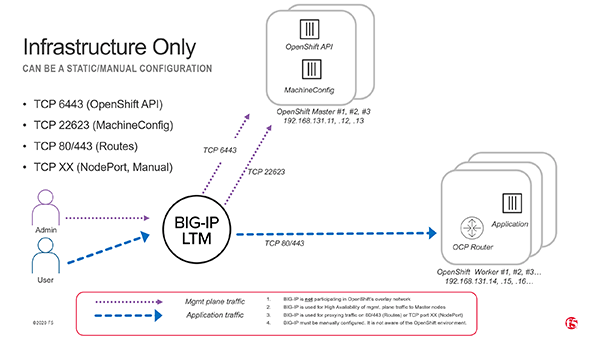
- This can be 'configured'/'setup' using a FAST template
- To use this at install time you must make sure that your configuration meets the OpenShift Product Requirements1
- Recommendations when using F5 BIG-IP as external load balancer
-
F5 Container Ingress Services (CIS) - F5 BIG-IP Local Traffic Manager (LTM) as a replacement to the OpenShift Router:

- Please see the F5 Container Ingress Service (CIS) documentation for install/setup instructions to get started with this configuration.

Comments